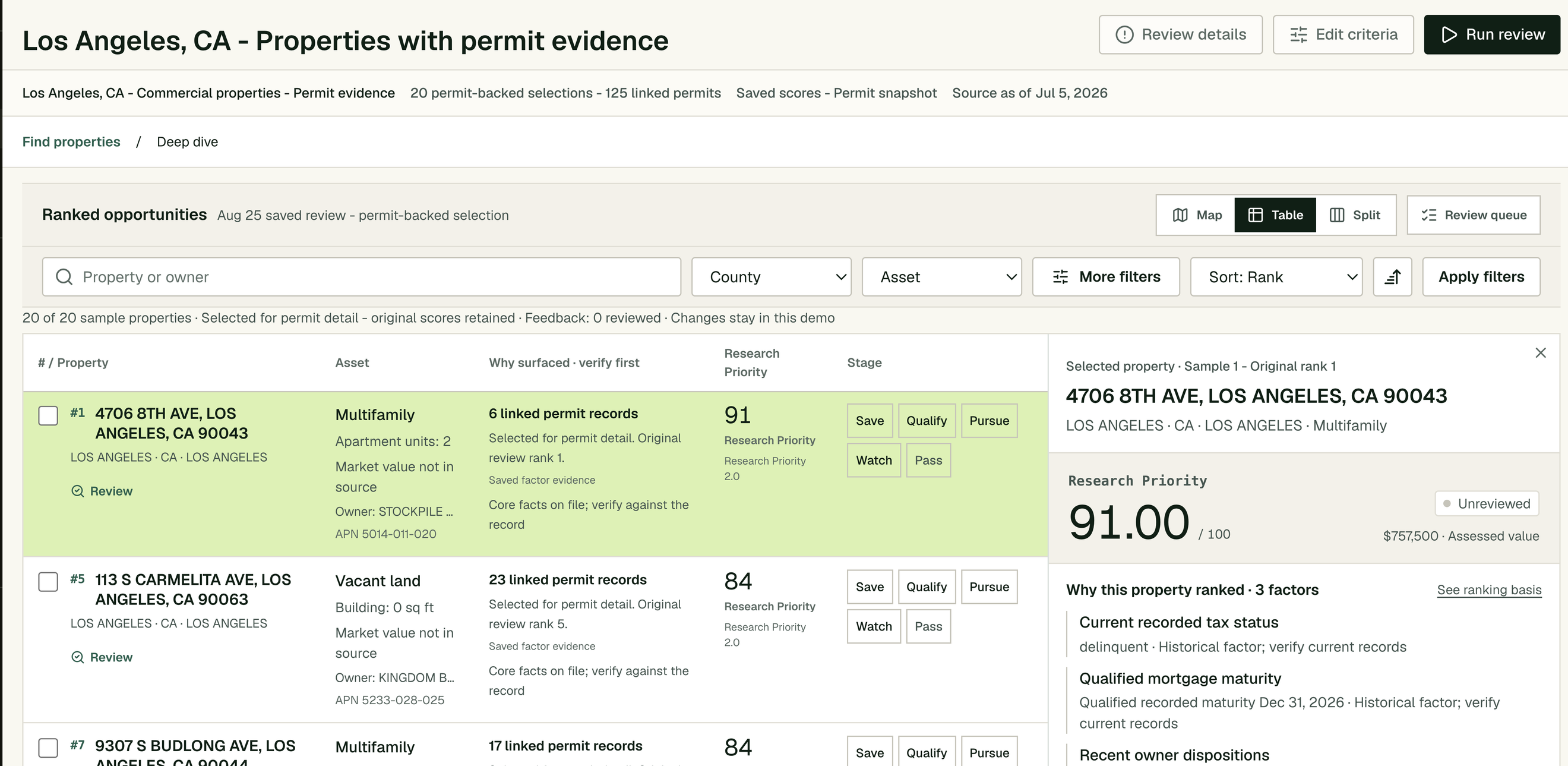
Screen properties against your buy box, research the recorded owner, and see the questions behind the opportunity before you spend more time underwriting. Property, tax, recorded debt, permit, and court evidence stay attached where available.
Actual product demo · Historical snapshot20 Los Angeles properties · 125 linked permitsSee how it works →
Fragmented Records
Eight sources become one record.
Before the next broker call, check that the parcel, recorded owner, and supporting records tell the same story. Acren brings available assessor, recorder, court, permit, and entity records together so conflicting details and unanswered questions stay visible.
Bring the source and the open question into the next conversation.
Select a field to trace it
Acren · Property Record
1250 Riverside Dr
Parcel 72-120-005
LineageSelect a field to trace its source
resolves into
Acren · Property Record
1250 Riverside Dr
Parcel 72-120-005
LineageSelect a field to trace its source
Eight public and private source documents — assessor record card, tax ledger, entity filing, recorded deed, municipal permit, court docket, GIS parcel and a broker spreadsheet — each contribute one field to a single Acren property record for 1250 Riverside Dr, with the originating source and date retained on every row.
Opportunity Pipeline
Find the properties you didn't know to search for.
Acren ranks commercial properties by research priority and shows exactly which signals surfaced them.
Acren · Acquisition Pipeline — Tarrant + Dallas↑↓ triage · enter open · s save · w watch
Rank
Property
Priority
Why surfaced
Owner / Entity
Evidence
State
01
2215 Harriett St
Arlington, TX
94Notable
Long ownership tenure
Recorded lien activity
+2 more
Harriett Holdings LLC
Bellview Capital
5 recordsComplete
Needs review
02
1250 Riverside Dr
Fort Worth, TX
91Notable
Entity portfolio overlap
Assessed value drift
+1 more
Riverside Commerce LLC
Riverside Commerce
5 recordsComplete
In research
03
8804 Cedar Springs Rd
Dallas, TX
88Elevated
Maturing recorded debt
Absentee ownership
+1 more
CSR Industrial LP
Cedar Springs Partners
4 recordsPartial
Watching
04
410 W Belknap St
Fort Worth, TX
83Elevated
Court judgment recorded
Vacancy signal
Belknap Realty Trust
Unresolved
6 recordsNeeds review
Candidate
05
5127 Mansfield Hwy
Kennedale, TX
79Watch
Permit lapse
Ownership tenure 21 yrs
M. & D. Prewitt
None on file
3 recordsPartial
Candidate
Why surfaced
Long ownership tenure
Recorded lien activity
Recent permit activity
Owner/entity relationship identified
Open question
Does the candidate entity relationship require another corroborating filing?
Follow a property from its recorded owner to the registered entity, its likely parent and the portfolio around it. Select a relationship to read the evidence behind it.
Property
1250 Riverside Dr
Parcel 72-120-005
Recorded owner
Acren record
Riverside Commerce LLC
Deed 2016 · grantee of record
Company registration
Texas Secretary of State
TX 0802341190
Active · filed 03/14/2016
Candidate parent
BC
Bellview Capital
Entity profile
AGENT
M. Alvarado
ADDRESS
900 Weatherford
Candidate portfolio
11 candidate properties
4 counties
Candidate parentCandidate relationship
Confidence96%
Supporting evidence
Shared registered agent · M. Alvarado
Shared mailing address · 900 Weatherford
Still needed
Corroborating manager overlap
Direct parent filing
Property
1250 Riverside Dr
Parcel 72-120-005
Recorded owner
Acren record
Riverside Commerce LLC
Deed 2016 · grantee of record
Company registration
Texas Secretary of State
TX 0802341190
Active · filed 03/14/2016
Candidate parentCandidate relationship
Confidence96%
Supporting evidence
Shared registered agent · M. Alvarado
Shared mailing address · 900 Weatherford
Still needed
Corroborating manager overlap
Direct parent filing
Candidate parent
BC
Bellview Capital
Entity profile
AGENT
M. Alvarado
ADDRESS
900 Weatherford
Candidate portfolio
11 candidate properties
4 counties
Ownership graph: 1250 Riverside Dr has recorded owner Riverside Commerce LLC, supported by a 2016 warranty deed. That owner matches Texas registration 0802341190. A candidate parent, Bellview Capital, is inferred at 96% confidence from a shared registered agent and mailing address, and still needs a corroborating manager overlap and a direct parent filing. A candidate portfolio of 11 properties across 4 counties is inferred at 88% confidence.
Evidence
Every answer should have evidence.
Conclusions remain separate from source records, so supporting, conflicting, and missing evidence stay visible.
Acren · Conclusions
2 source records highlighted
County RecorderRecorded 06/2016
Grantee
THE STATE OF TEXAS, COUNTY OF TARRANT. That the undersigned Grantor, for good and valuable consideration, has GRANTED, SOLD AND CONVEYED unto Riverside Commerce, L.L.C., a Texas limited liability company, its successors and assigns, the following described tract situated in Tarrant County.
Instrument 2016-0044120Maturity not stated
County Assessor2026 certified roll
Owner of record
SITUS
1250 RIVERSIDE DR
CLASS
COMMERCIAL F1
LAND
84,000 SF
OWNER
RIVERSIDE COMMERCE LLC
Secretary of StateFiled 03/2016
Legal name
Certificate of Formation
Filing on record for RIVERSIDE COMMERCE LLC · File 0802341190 · Status Active · Registered agent M. Alvarado, 900 Weatherford St.
Municipal PermitsIssued 11/2024
Applicant
PERMITB24-118402 · Tenant finish-outSITE1250 Riverside Dr, Suite 200APPLICANTRiverside Commerce LLC
Four Acren conclusions — recorded owner (supported), entity registration (supported), candidate parent (needs review) and mortgage maturity (missing) — each linked to the county assessor roll, the recorded deed, the Secretary of State filing and a municipal permit that support or fail to support them.
Coverage
Confirm coverage for your market.
Research depth varies by geography, record type, and source. Review the coverage directory, then confirm the scope that matters to your team.
Check the state, county, and metro relevant to your acquisition search. Availability can differ within the same market.
Check the record types
Property, ownership, entity, permit, and recorded-document coverage depend on the source. A property record does not imply every supporting record is present.
Confirm access before starting
Requested markets and approved workspace access are separate. Confirm the market and research scope before starting a Beta trial.
Get started
Find your next property.
Search a property address or parcel/APN and open one free public preview.